Other Shores
Other Shores is a 2D top-down mystery-adventure game developed in Unity by five-person student indie studio RayLine, blending cozy life-simulator mechanics with an unraveling psychological narrative. Players explore a simulated coastal town, build relationships with anthropomorphic residents, and piece together keyword clues to clear digital anomalies and uncover the dark truth behind their world.

Overview
Official Links & Media:
Playable Build (Itch.io): Other Shores on Itch.io
Full Project Documentation: Other Shores Notion Documentation
Official Trailer: Other Shores - Trailer
Extended Gameplay / Showcase Video: Other Shores - Gameplay
Developer Diaries: RayLine Dev Diaries on Medium
Role: Game Designer, Level Designer, Lead Sound Designer, Business & Social Media Strategist
Course & Studio: AET 358 Indie Game Studio (RayLine) | Fall 2024
Core Tools: Unity, GitHub, FL Studio, Figma, Notion, Itch.io
I. Conceptualization, Scope Evolution & Narrative Premise
Developed during the Fall 2024 semester by our five-person indie student studio RayLine (Alexander Le, Amelia Lewey, Chelsea Nguyen, Phoebe Reeder, and Renee Neufer) for UT Austin's AET 358: Indie Game Studio course, Other Shores (initially prototyped under the working titles Dying World and Nothing Is Wrong Here) is a single-player 2D mystery-adventure game set inside a fracturing digital simulation.
The Meta-Simulation Concept
In the game's overarching lore, several people from the real world immerse themselves inside a peaceful digital community to escape real-life grief and trauma. Each human inhabitant believes they are inside a single-player experience surrounded by comforting digital constructs (NPCs), unaware that other real players are also trapped in the simulation. When real-world pressures and memories bleed into the program, digital anomalies (glitches) begin corrupting the environment, blocking pathways, and causing residents to vanish from the town's collective memory.
Chapter-Style Scope Refinement
In our early Game Design Document (v0.1 – v0.4), we envisioned a three-town world spanning a touristy Beach Town, a cozy Forest Town with woodland creatures, and a Snowy Mountain populated by winter-themed "snow globers." Following our September scope review (RayLine Project Scope & GDD Changelog v0.5 – v0.6), we adopted a chapter-based development model inspired by indie narrative RPGs like Deltarune:
Focused Vertical Slice (Chapter 1: The Beach Region): Rather than stretching our five-person team thin across disconnected fragments of three regions, we concentrated Chapter 1 entirely on the coastal tourist town (introducing tourist NPCs visiting from the other regions) and cut an early "social attributes" stat mechanic so we could polish core exploration, branching dialogue, and anomaly puzzle resolution.
Characters & Narrative Progression: Players control Dot, a new arrival accompanied by a floating companion named Buddy. Exploring the coastal town, Dot interacts with Mayor Bearkins (inside Town Hall), Captain Otto (running the beach Fishing Shack), Marcelo (running the General Store on the edge of town), Sally, and Roscoe.


II. Systems Architecture & Core Gameplay Loop
In our Systems Design Document and Week 8 – 11 Documentation, we structured the gameplay around two primary objectives: Exploration and Alignment (Solution).
1. The Anomaly & Keyword Puzzle Loop
To progress through blocked areas and uncover why townspeople are disappearing, players engage in a multi-step investigative loop:
Encountering Anomalies: Digital anomalies physically block key doors, pathways, or objects across the town.
Questing & Clue Gathering: By conversing with NPCs through branching dialogue trees and completing errands (such as presenting a Pretty Shell from the beach to Mayor Bearkins to receive a Seashell Necklace with the letter "O" engraved on the back, or finding a house key and note left behind by Sally's grandfather), players collect clues containing highlighted letters.
Keyword Resolution: Combining the highlighted letters from collected clues forms a specific keyword (password) that unlocks and clears the anomaly, opening new indoor/outdoor areas and triggering follow-up story beats.
2. Moral Dilemmas & Planned Ending States
As documented in our Systems Design and Week 8 Design Logs, we had to rationalize a central narrative paradox: "saving" the real people trapped in the simulation effectively means shutting the simulation down and deleting the digital constructs who want to stay. To reflect this tension, we designed the narrative around internal monologues and three (3) distinct outcome trajectories:
The "Wake Up" Ending (Best Outcome): The player investigates every anomaly, earns the trust of the town, and helps everyone wake up to face reality and set healthy boundaries with escapism.
The Solitary Patch Ending (Neutral Outcome): The player tells no one about the glitches and attempts to quietly patch the anomalies alone, clinging to the comfort of the simulation.
The Loss of Expression Ending (Bad Outcome): If the player aggressively pushes the truth onto unreceptive NPCs three (3) times (receiving warnings after the first and second attempts), the simulation forces a reset on the player's self-expression.
III. Visual Direction, Hybrid Perspective & UI/UX Pipeline
To balance a comforting, Animal Crossing-inspired surface with an increasingly uncanny atmosphere, our art and UI documentation (Art Style Discussion & RayLine UI/UX Notes) established strict technical standards across three artists:
Visual / UI Layer | Technical Specifications | Design Execution & Player Experience |
Top-Down Map Exploration |
| Warm coastal palette (tans, pale yellows, warm oranges, and aquamarine blues) that gradually drops in saturation and brightness as anomalies spread. |
Dual-Grid Tile & Layer Sorting | Custom dual-grid ground tile system and dynamic Y-axis layer sorting in Unity | Reduced ground tileset production workload by 3x for our artists while allowing the player to walk seamlessly in front of and behind buildings and flora. |
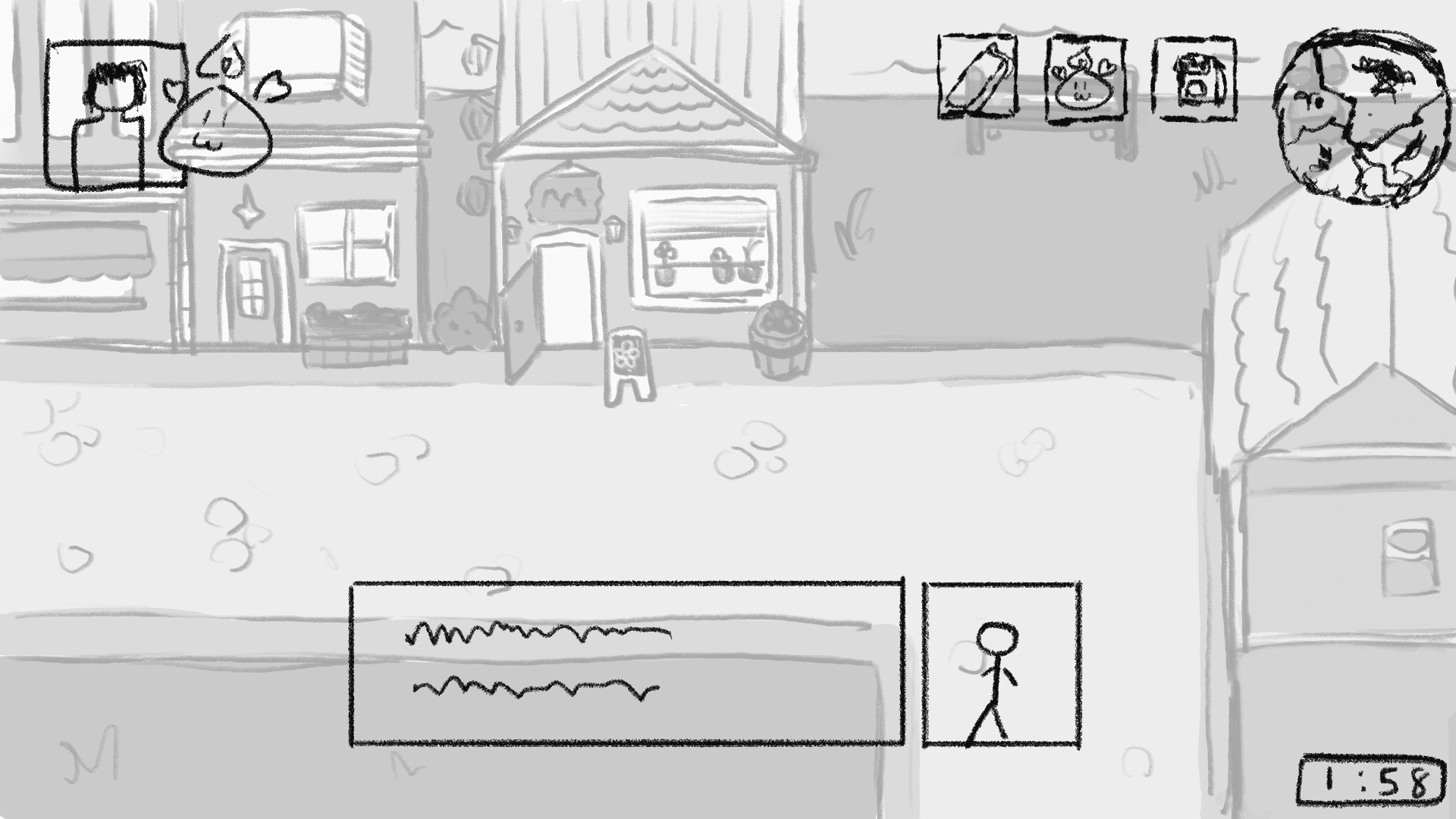
Hand-Drawn Interior Scenes | Full-screen illustrated 2D interiors modeled after shop layouts in Undertale | Entering buildings (such as Town Hall, the General Store, or the Fishing Shack) transitions from top-down pixel art to expressive, hand-drawn character portraits with bottom-anchored dialogue boxes. |
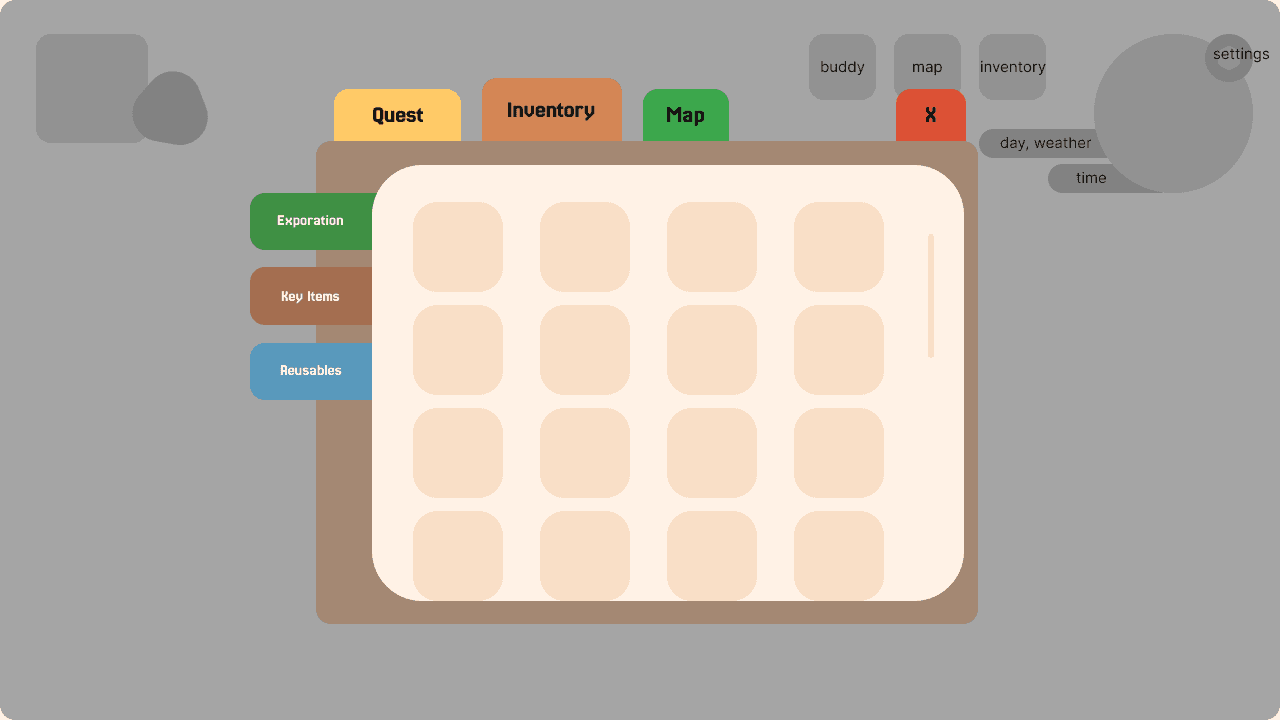
Figma UI/UX & "Buddy" Menu | Custom Purple UI theme wireframed in Figma | Features a right-aligned Title Screen (with save-overwrite protection), a backpack Inventory grid, a regional/subregional Map, a Quest Log / Journal, and a Companion (Buddy) Button that consolidates all quick-access menus. |
IV. Audio Direction & Lead Sound Design
As Lead Sound Designer, I began prototyping the sonic identity of Other Shores in Week 1 (Prototype Development Log). During our initial rapid-prototyping sprint, I discovered that composing full original tracks from scratch for every mood test took too much time away from early iteration. To solve this, I paired reference moodboards (drawing inspiration from Ichiko Aoba, Bonnie Beecher's "Come Wander With Me" from The Twilight Zone, and Grimshire) with an original acoustic prototype demo titled if you were a marigold.mp3.
Organic Acoustic Instrumentation: Composed in FL Studio in Eb Major using layered acoustic guitars (2 to 3 tracks), subtle clarinet waves, vocal echoes, and environmental foley (rain, vinyl crackle, and coastal nature sounds), the music establishes a nostalgic, warm, and slightly melancholic tone that makes the sudden appearance of digital glitches feel jarring.
In-Game Audio Architecture: Collaborating with Renee Neufer on interaction SFX, we designed the Settings Audio Tab around five (5) independent mixer controls: a Mute All Toggle alongside individual sliders for Master, Environment, SFX, and Music volume.
V. Iterative Development Sprints & Playtest Evolution
Tracking our progress across our Changelog, Prototype Development Log, and Weeks 8 – 12 Sprint Presentations highlights how each playtest directly shaped the final v1.1 build:
Development Milestone | Build / Timeframe | Key Technical, Art & Design Updates |
1. Prototype & Mock-Up Sprints | Weeks 1 – 4 (Sept 2024) | Established Unity movement and doorway scene transitions; created dual moodboards (cheery town vs. glitched world); refined shadow color palettes from cool to warm tones based on early sprint critiques. |
2. First Playable & Dialogue Overhaul | Weeks 6 – 8 (Oct 2024) | Delivered |
3. Playtest 1 (v0.4) & Feedback Sprint | Weeks 9 – 10 (Late Oct 2024) | Players praised the cozy art, sound design, and fishbowl/rat NPC designs, and everyone solved the initial house-key anomaly puzzle. However, playtesters noted that picking up items needed visual feedback (not just audio) and that the next step after clearing an anomaly was unclear. |
4. Playtest 2 (v0.7) & Level Design | Weeks 11 – 12 (Nov 2024) | Connected the new modular inventory and quest systems directly to dialogue actions; added immediate post-anomaly dialogue cues; implemented functional indoor areas and the dual-grid tile system; standardized Unity prefabs and GitHub workflows to assemble the final Beach and Town levels. |
5. Final Polish & Showcase (v0.8 – v1.1) | Late Nov – Dec 2024 | Finalized narrative continuity across Mayor Bearkins, Captain Otto, Marcelo, and Sally; published the polished Windows executable ( |
VI. Studio Operations: Business Strategy & Multi-Channel Marketing
Alongside game design, level building, and sound design, I helped lead RayLine's studio operations and outward marketing:
Business & Legal Strategy: Co-authored our formal Business Plan & Legal Strategy, establishing a direct-to-consumer digital storefront model (targeting the 20 to 30 age demographic on Steam and Itch.io), outlining Unregistered Copyright and future USPTO trademark protections across our six (6) core IP pillars (code, assets, names, artwork, audio, and narrative), and committing to an ad-free, microtransaction-free release to preserve narrative immersion.
Twice-Weekly Social Media Rollout: Managed our Wednesday/Friday content calendar across Instagram (
@raylinesocial), TikTok, YouTube Shorts, and Medium (RayLine Dev Diaries), showcasing sketch-to-final character turnarounds, walk/spin cycles, Photoshop and Unity environment pans, interactive UI previews, and whitebox progress sprints.
V. Reflection
Building Other Shores from initial concept pitches in September to a polished, playable build on Itch.io taught me how every discipline in game development relies on clear documentation and version-controlled collaboration. Balancing my work as Lead Sound Designer and Level Designer in Unity with writing our studio's business strategy, Dev Diaries, and storefront copy gave me a complete view of what it takes to ship and market an independent game. Watching playtesters connect with our characters, solve the keyword anomaly puzzles, and react to the town's dark narrative twists made the entire semester's sprint cycle deeply rewarding.